All PostsAugust 13, 2025
A Guide on How to Reduce Churn Rate

Written by Ayo Abdul
To effectively reduce customer churn, you need to be proactive, not reactive. The work begins the moment a customer signs up. It's about implementing a flawless onboarding process, maintaining engagement with genuinely useful communication, and actively listening to customer feedback to preemptively solve problems before they lead to cancellations.

Customer churn is more than just a leak in your revenue bucket; it's a direct brake on your growth. Every lost customer takes a piece of your Monthly Recurring Revenue (MRR) with them, forcing you to fight an uphill battle. Viewing churn reduction not as damage control but as your most powerful growth lever is a game-changing shift in perspective.
It costs significantly more to acquire a new customer than to retain an existing one. By focusing on lowering your churn rate, you’re not just plugging a leak—you're reinforcing your entire business foundation. This effort directly improves the financial metrics that matter most.
Lowering your churn rate creates a positive ripple effect across your business. Here’s a look at the direct impact on core metrics:
Actionable Insight: A mere 5% increase in customer retention can boost profits by an astounding 25% to 95%. This makes figuring out how to reduce your churn rate one of the highest-ROI activities you can undertake.
To fix your churn problem, you must first measure it correctly. The basic formula is straightforward, but it's crucial to distinguish between the two primary types:
Churn rates vary significantly by industry. For instance, cable and finance may see churn as high as 25%, while big-box electronics stores hover around 11%. Much of this is tied to customer experience; 59% of U.S. customers report they will leave a brand after a few bad experiences. Improving that experience can cut churn by about 15%.
The goal is to shift your mindset: stop treating churn as an unavoidable cost. Instead, make its reduction a core strategic objective. To delve deeper into actionable tactics, you can explore these effective customer retention strategies.
If a new customer has a rocky start, they are unlikely to stay for the long term. Your onboarding is their first meaningful interaction with your product and sets the tone for the entire relationship. Nailing this initial experience is one of the most direct and powerful ways to reduce churn before it starts.
The objective is to guide users to their "aha!" moment as quickly as possible—that instance when they truly understand the value your product delivers. The faster they reach this point, the less likely they are to become frustrated, disengaged, or question their decision to sign up.
A generic, one-size-fits-all onboarding flow is a recipe for churn. Your approach must be tailored to the user. For a high-value enterprise client, a personal setup call with a dedicated success manager provides white-glove treatment and ensures they are configured for success from day one.
For smaller accounts or individual users, create an automated journey that still feels personal. Here are actionable strategies that work:
Actionable Insight: The best onboarding isn't a feature dump. It's a guided journey to the customer's first small victory. Help them win early to lay the groundwork for a loyal, long-term relationship.
The image below outlines a process for diagnosing why customers are leaving—a problem that often stems from a flawed onboarding experience.
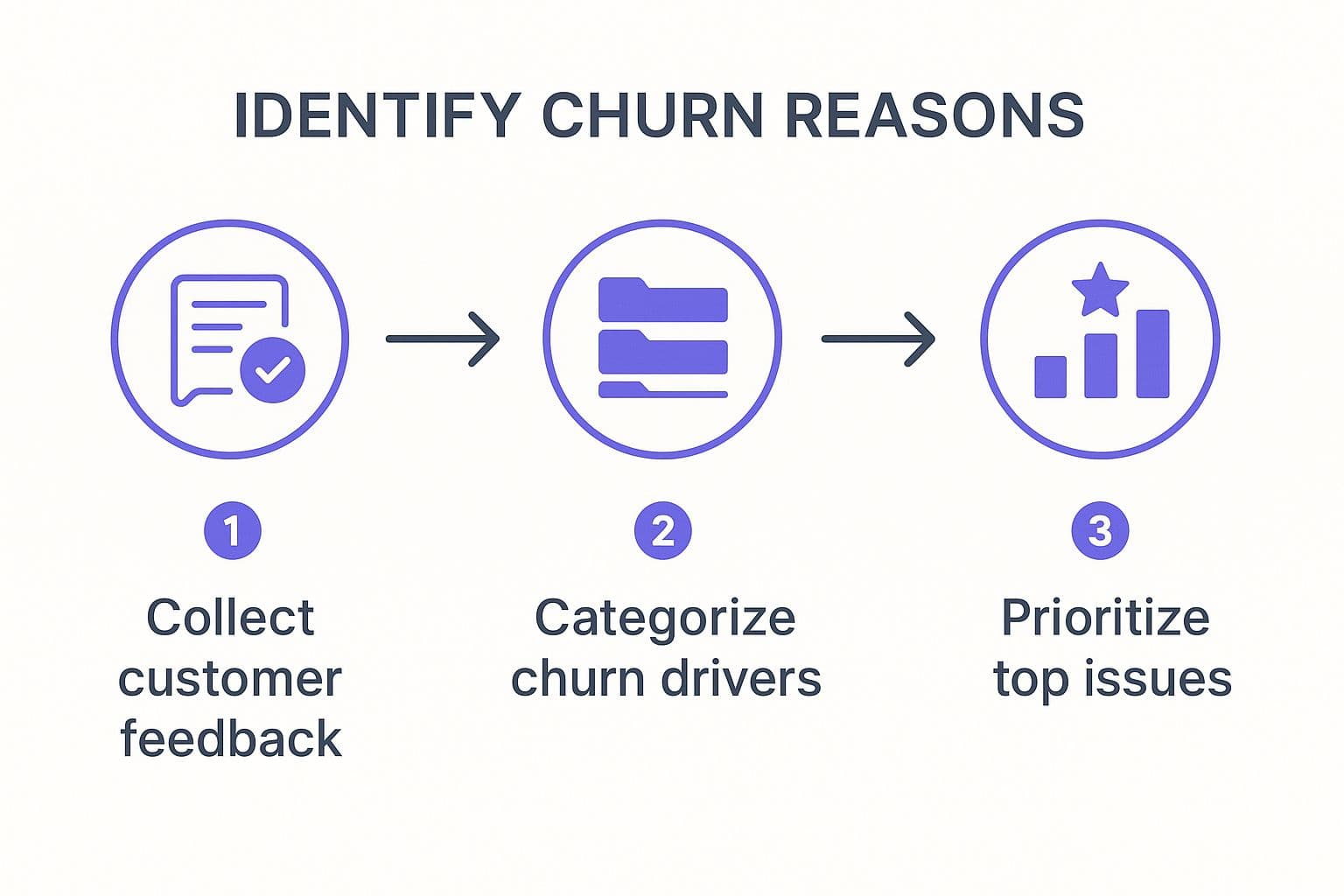
As shown, gathering feedback and understanding churn drivers are the first steps toward fixing your onboarding and enhancing the entire customer journey.
Investing in onboarding is not a "nice-to-have" expense. In the B2B SaaS world, where the average churn rate is around 3.5%, every retained customer counts. In fact, recent data from Vitally reveals a 3.3% drop in churn that coincided with a slowdown in new sales, signaling a clear shift from pure acquisition to retention and expansion.
To help you implement this, here’s a breakdown of key activities and their direct impact on retaining new customers.
| Onboarding Activity | Objective | Impact on Churn Reduction |
|---|---|---|
| Interactive Product Tour | Guide users to their "aha!" moment quickly. | Reduces initial frustration and confusion, demonstrating value in the first session. |
| Welcome Email Series | Provide a structured path to success. | Keeps users engaged and on track, preventing them from falling off after sign-up. |
| Personalized Setup Call | Address complex needs for high-value accounts. | Creates a strong, personal connection and ensures the product is configured for maximum ROI. |
| In-App Checklists | Motivate users to complete key actions. | Gamifies the setup process, leading to deeper product adoption and habit formation. |
| Proactive Help Resources | Empower users to self-serve. | Builds user confidence and reduces reliance on support tickets for common questions. |
A well-executed onboarding process creates a powerful foundation that significantly reduces the risk of early-stage churn.
A great onboarding experience can even become a growth engine. A happy, successful user is the perfect candidate for a referral or an invitation to your affiliate program. After experiencing value firsthand, they are much more likely to spread the word. If you're looking to develop this, our guide on how to recruit affiliates can help.
By making an unforgettable first impression, you not only reduce churn—you create your most powerful advocates.

You've nailed the onboarding. Your new customer is ready to go. The worst thing you can do now is go silent, only to reappear with a generic marketing newsletter that's immediately deleted.
Meaningful, ongoing communication builds loyalty and prevents customers from leaving. Shift your mindset from broadcasting announcements to having valuable conversations. Every communication should be designed to help your customers succeed. When you consistently deliver this kind of value, you become an indispensable partner.
The one-size-fits-all email blast is obsolete. To keep customers engaged, you must address what they actually care about. This requires smart behavioral segmentation. Instead of grouping users by generic firmographics, segment them by their actions (or inactions) within your product.
Here’s how to apply this:
This targeted approach makes every message feel personal and relevant, increasing open rates, engagement, and action.
Actionable Insight: Meaningful engagement is proactive. It’s about anticipating your customer's next need and offering a solution before they even have to ask. This builds trust and makes your product indispensable.
Customers need to feel heard. While establishing feedback channels is a good start, what you do with that feedback is what truly matters. When users see their suggestions implemented or their issues quickly resolved, they become invested and feel a stake in your product's future.
This became evident in the consumer packaged goods (CPG) sector during the pandemic, when churn rates soared to 40%. In response, smart companies like Coca-Cola HBC began communicating with customers more frequently to spot risks and gather crucial feedback before accounts churned. You can explore more of these industry-specific churn challenges on CustomerGauge.com.
Build a proactive listening engine with these practical tactics:
By listening and, most importantly, acting on feedback, you turn passive users into your biggest advocates. A happy, engaged customer is the perfect candidate for your referral program. For more on this, see our guide on building an affiliate program that turns customers into partners.
Collecting customer feedback is one thing; using it to predict churn is another. Many businesses have piles of survey responses collecting digital dust. The real value comes from connecting the dots to build a system that alerts you to a customer's departure before they decide to leave.
This requires a fundamental shift in mindset. Treat feedback not as a report card on past performance, but as a crystal ball for the future. Create a deliberate process to gather, analyze, and, most critically, act on the signals your customers are sending.
To do this effectively, you must first master the art of listening. Learning how to effectively gather customer feedback is the foundation of any predictive strategy.
The most telling signs of churn are often subtle. You need to tune into the quiet shifts in behavior that precede a formal cancellation.
Be vigilant for these red flags:
This is more than just theory. McKinsey found that companies that use analytics to spot these signs can reduce churn by up to 15%. You're not just putting out fires; you're preventing them.
Once you've spotted the warning signs, you need a playbook to turn that data into a targeted response. A generic "we miss you" email is not enough. Your action must be specific, helpful, and address the likely reason for their disengagement.
Actionable Insight: Don't wait for the exit interview to learn why a customer is unhappy. By then, it’s almost always too late. Create a "churn radar" that empowers your team to intervene with the right support at the right time.
Here's how to make this practical: if a high-value account’s usage metrics dip, automatically trigger an alert for their customer success manager to schedule a proactive check-in. If a user leaves a poor CSAT score after a support ticket is closed, have a manager personally follow up to understand what went wrong and make it right.
This approach transforms your customer success team from reactive firefighters into proactive problem-solvers. It's also an excellent way to identify your biggest fans. Happy, engaged customers who consistently provide positive feedback are prime candidates for case studies and referrals. Exploring the benefits of affiliate marketing can show you how to turn these advocates into a powerful new growth channel.

When a customer is at risk of churning, the first instinct is often to offer a discount. While it may provide a temporary fix, this approach is dangerous. It trains customers to devalue your product and negotiate for better terms, creating a race to the bottom you can't win.
A more sustainable strategy is to build incentives that reward genuine loyalty, not just the threat of leaving. This isn't about short-term bribes; it's about making your product an integral part of your customer's success. The goal is to make them feel like a valued partner, not just a bargain hunter.
True loyalty cannot be bought with a 20% off coupon. It's earned by creating an experience your competitors can't replicate. Focus on what makes a customer feel special: status, exclusive access, and recognition.
Here are actionable ways to do this:
Incentives like these build deep, structural loyalty. A customer would have to give up more than just software; they would be sacrificing VIP status and a valuable support relationship.
Actionable Insight: Compete on the value of the experience, not on price. A discount is a fleeting transaction, but feeling like a VIP creates an emotional bond that fosters long-term retention.
One of the most effective ways to secure customer loyalty is to get them invested in your company's growth. A well-designed referral program does exactly that, turning your happiest users into your most effective advocates. When a customer successfully refers a new client, their own commitment to your platform deepens, as they've put their reputation on the line.
The key is to make the reward mutually beneficial. Instead of a one-off cash bonus, offer service credits or a recurring commission that reduces their own subscription costs. For example, a 15% recurring commission on every referred customer is a powerful, ongoing motivator. It's a partnership that directly impacts their bottom line.
This approach reinforces their decision to choose you every month, transforming them from passive users into genuine partners in your success and creating a powerful, organic growth engine.
Even with a solid plan, you're bound to have questions pop up as you start digging into your own churn numbers. Let's tackle some of the most common—and practical—concerns I hear from businesses trying to get a handle on customer retention.
This is the million-dollar question, but honestly, there's no magic number that works for everyone. What’s considered "good" really comes down to your industry, business model, and even the age of your company.
A typical SaaS business might aim for a monthly churn rate between 3-5%, which is often thrown around as a healthy benchmark. But context is everything. An enterprise SaaS company selling massive contracts will want to see that number closer to 1-2%, while a business in wholesale, where switching suppliers is common, could see churn as high as 56%.
Actionable Insight: Forget about chasing a universal number. The best thing you can do is benchmark against your own history and your direct competitors. Your real goal should be consistent, incremental improvement. Beating last quarter's churn rate is a much more powerful metric than hitting an arbitrary industry target.
Getting ahead of churn means learning to read the tea leaves. You have to combine hard data with the softer, more subtle shifts in customer behavior to see the full picture.
On the data side, keep an eye out for these quantitative red flags:
But don't ignore the qualitative signals. They're just as telling:
Actionable Insight: Use a Customer Success Platform or a well-configured CRM to track these health scores automatically. Set up alerts that notify your team when a customer's behavior changes, enabling proactive intervention before it’s too late.
If I had to put all my chips on one single thing, it would be the customer onboarding experience. Hands down, this is where you'll get the biggest and fastest return on your effort.
A great onboarding process gets customers to that "aha!" moment as quickly as possible, showing them the real value of your product right from the start. This is your best defense against early-stage frustration and abandonment. Think about it: if someone doesn't see the point of your product in the first couple of weeks, you'll have a tough time convincing them to stick around later, no matter how many cool features you release.
Actionable Insight: A smooth, educational, and value-packed onboarding isn't just a nice-to-have; it's the foundation for the entire customer relationship.
It's tempting to throw a discount at a customer who's about to walk away. It feels like a quick, easy fix. But in the long run, adding more value is a much stronger, more sustainable strategy.
When you constantly rely on discounts, you risk devaluing your product and attracting price-sensitive customers who will just leave again as soon as a cheaper competitor comes along. Instead, channel that energy into making your service indispensable. You can do this by:
Actionable Insight: A last-minute discount might save an account in an emergency, but your core strategy should always be built around enhancing value, not cutting prices. Actions like these build real, sticky loyalty that a 10% discount could never buy.
Ready to turn your happiest customers into a powerful growth engine? Push Lap Growth makes it easy to build, manage, and scale a world-class affiliate program. Start your free trial and see how our platform can help you drive new revenue and reward loyalty.